Wings and fins bend…in the same way

1024px-Southern_right_whale_caudal_fin-2_no_skyWhat do a bat, a jellyfish and a humpback whale have in common? For one thing, these animals use their natural propulsors, such as wings, bells and flukes, to move through their environment, be it air or water. Last week a group of researchers published a study in Nature Communications that indicates that these and many other animals from distantly related groups seem to have attended the same school of propulsion. And one of the subjects they studied there was all about being flexible.

Continue reading

Children will learn from robots

We featured a previous post on one of the most emotionally literate robots in the world Nao, who was developed by Aldebaran Robotics and is currently being used by the ALIZ-E project scheduled to end this year. This cute robot has been tested at aged care facilities and proved helpful for such tasks as monitoring and reducing people’s anxiety levels by engaging with them emotionally.

Now, another European project is testing Nao in a slightly different role – that of a tutor. Needless to say, EMOTE, a three-year research project launched in 2012, also picked up Nao for his ability to empathise.

Continue reading

Swarm construction

Watch these termite-inspired robots in action 

Termites are some of nature’s most magnificent architects that can easily build complex mounds that exceed their own size by several orders of magnitude – occasionally reaching up to nine meters in height. Paradoxically enough, each of these tiny insects does not have even a remote idea of what kind of structure it is building, nor does it receive orders from any termite authority. In fact, the termites’ architectural prowess makes no sense except in the context of swarm intelligence.

Continue reading

Collaborative Robots

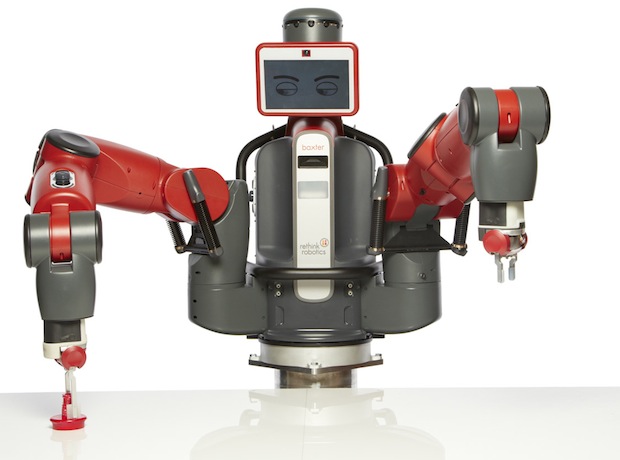
Baxter was released in 2012 by Rethink Robotics as one of the first affordable collaborative robots

Baxter was released in 2012 by Rethink Robotics as one of the first affordable collaborative robots

Past are the days when working alongside manufacturing robots was rightly considered an obvious health risk. Collaborative robotics, one of the biggest trends in the modern robotic industry, is rapidly revolutionizing the way we view manufacturing robots. While larger heavy-duty machines continue working in isolated safety cages, a whole new generation of collaborative robots is more than ever ready to share workspace with humans. Simple programming, reasonable price, precision and safety are probably the biggest advantages this kind of robots can boast of.

Continue reading

How ready are disaster-response robots?

Sandia Lab's Gemini-Scout Credit: Randy Montoya

Sandia Lab’s Gemini-Scout
Credit: Randy Montoya

The December DARPA trials saw possibly the biggest congregation of state-of-the-art humanoid robots ever. The DARPA Robotics Challenge was launched in 2012, after the Fukushima nuclear meltdown vividly demonstrated how unpractical our most advanced humanoid robots were for disaster response. Since then, things have improved considerably: robots have learned to climb ladders, open doors, turn valves and even drive vehicles. But are they ready to survive a full-scale rescue mission? Continue reading

Biomimetic robots at Robot SafariEU in London

1470230_10152443459874676_205650588_nRoboticists from across Europe showcased the most advanced biomimetic robots so far at the Robot SafariEU, an event organized by the Science Museum of London. The Robot SafariEU offered its visitors a special experience with a unique landscape of synthetic creatures able to run very fast like robot cheetah, stretch their wings like the rob-bat, crawl like the robot salamander, swim like a fish or like the robotic turtle U-CAT that is built to explore the deep seas. Continue reading

IROS 2013

IROS 2013

This year’s International Conference on Intelligent Robots and Systems (IROS2013) was held in Tokyo, Japan— a globally recognized hotspot for some of the most fascinating robots on earth. Under the name of New Horizon, this conference aimed to get participants looking forward towards a new era of intelligent systems capable of meeting the needs of the fast-changing times we live in.
Continue reading

ICT 2013: Create, Connect, Grow

From November 6–8, nearly 5000 of Europe’s top researchers, engineers, industry representatives, politicians, journalists, entrepreneurs, and students gathered in Vilnius, Lithuania to share insight and future visions for the future of ICT in Europe. The global event also provided  an inspiring setting for the discussion of European ICT policy as well as networking opportunities for business, research, and innovation groups.
Continue reading

Bio-Inspired Flight Takes Off

While creepy, crawly, or just plain gross, insects are in fact the object of many scientists’ affections.Those involved in the field of biomimicry are attempting to figure out exactly how some of these fascinating critters have honed in on some pretty amazing skills.
Continue reading